
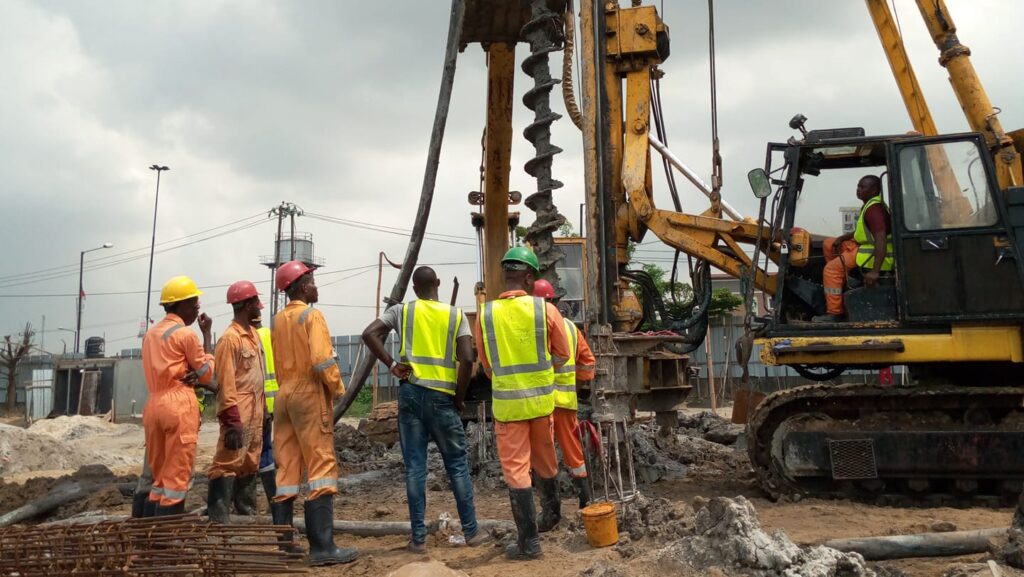
DISPLACEMENT PILING
Bored displacement piles are usually employed in ‘brownfield’ sites where the cost of removing spoil off site is expensive. While the technique is relatively new it is now widely considered to be an acceptable, and often attractive, alternative foundation solution. The piles are produced and cast in-situ with minimal creation of spoil using low noise and vibration techniques.
Bored displacement piles can be constructed to depths of up to 26m in a range of diameters. Piles can be designed to carry lateral and tension loads as well as bending moments.
Advantages
The bored displacement pile is suited to a range of soil types and can improve the strength of the soil during its installation.
Minimal spoil production leads to reduced costs for site plant, haulage, and disposal and provides an ideal solution for brownfield sites where contamination may be an issue. Production can be faster also because of the absence of spoil to clear from the head of the pile. On contaminated sites, the risk associated with handling spoil is eliminated. This method is also attractive where there are local restrictions on the amount of construction traffic permitted on the surrounding roads and highways.
The improvements to the soil lead to a more efficient pile design (when compared to other pile types of bored pile), due to the greater pile capacity and load transfer to the surrounding soils.
Improved load transfer to the surrounding ground is achieved through an enhanced shaft capacity and a thick concrete ‘thread’ is formed in the construction process that facilitates the load transfer from pile core to soil. This is achieved through the creation of an increased diameter/surface area and the bearing effect of the thick threads formed.
Basic Technique
A hollow-stemmed displacement auger is rotated into the ground, displacing the soil laterally and resulting in a localized, increased relative density and strength around the pile (depending upon soil conditions). This avoids the need to deal with large volumes of spoil at the surface of the ground. Just as in CFA piling, as the auger is withdrawn, concrete is pumped down the hollow stem while the operator monitors the concrete pressure and flow rate, forming a shaft of liquid concrete to ground level. A reinforcing cage is then inserted into the wet concrete using a ‘cage-vibrator’.