

What is CFA Piling?
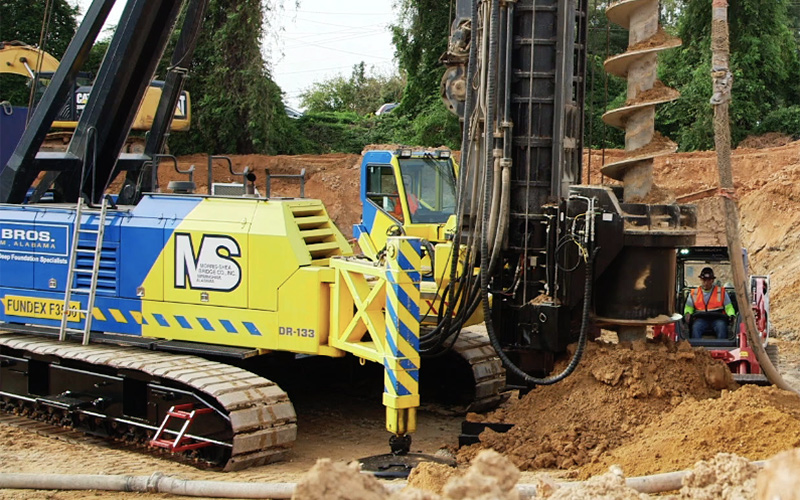
The Continuous Flight Auger (CFA) technique is one of the quietest piling solutions available and is virtually vibration-free, making it ideal for working in close proximity to existing buildings or in environmentally sensitive areas. CFA piles can also be installed relatively quickly and economically without the need for casing, bentonite, or polymers, in both cohesive materials such as clay and non-cohesive material such as sand, gravels, and glacial tills. CFA piles are suitable for both load-bearing piles and for contiguous or secant retaining walls.
Basic Technique
A hollow-stemmed continuous flight auger is rotated into the ground to the required depth or degree of resistance. As the auger is withdrawn, concrete is pumped down the hollow stem at a specific flow rate and pressure to maintain the pile shaft from collapsing, or voids forming in the concrete, this process is crucial to the success of the pile and is monitored closely by the rig operator by the use of computerized instrumentation. After the auger is extracted and the pile concreted to the surface, a reinforcing cage is then inserted into the wet concrete by excavator or by using a cage-vibrator for longer cages.
Our fleet includes CFA rigs weighing between 25 and 155 tonnes which are capable of installing piles up to 35m deep, and with pile diameters ranging from 350mm to 1200mm.
GTGABOD LTD. have an experienced team of design engineers in-house who can work promptly and proficiently to overcome unforeseen site conditions (as they arise) to mitigate potential delays. Further, we can review geotechnical information at any stage of the project and value-engineer the design to reduce costs or program duration.
Cased CFA Piling
Cased CFA combines the benefits of a rotary and a CFA solution proving particularly beneficial and effective when installing larger contiguous and secant-piled retaining walls. The single flight auger allows much faster continuous drilling whilst the casing helps to keep the pile vertical, within tolerance and in the case of a secant piled wall, watertight. The rotary drive units for the casing and the augers are connected but rotate in opposite directions, simultaneously drilling them into the ground. As in a traditional CFA technique, the spoil travels up the auger string and is deposited from the top of the casing into a series of telescopic tubes safely expelling it directly into a disposal vehicle, a skip, or to a holding area at ground level.
Concrete is then pumped through the hollow stem of the auger as it is retracted and the cages are installed once the pile is complete.
Advantages
- Minimal disturbance, hence limited risk of damage to adjacent structures
- No casing is required
- Suitable for all soil types
- Ideal for retaining walls
- Speed of installation
Instrumentation
All GTGABOD’s CFA rigs are fitted with the latest generation NDT piling rig computer systems – a fully integrated interactive tool with a touch-screen interface in the rig cabin which enables our CFA rig operators to monitor and accurately control all aspects of the pile construction consistently and to specific quality-controlled specifications. As each pile is completed, the pile data is transmitted from the rig via a cell phone network to the ‘cloud’ for review on a net-connected device, thereby enabling real-time quality control. The system provides instant data on important parameters such as:
- Auger depth
- Auger rotations
- Penetration speed
- Rotary torque
- Crowd winch force
- Extraction force
- Extraction speed
- Concrete pressure
- Concrete flow
- Total concrete volume pumped
- Productivity